
The Life He Chose
Chapters 11–14
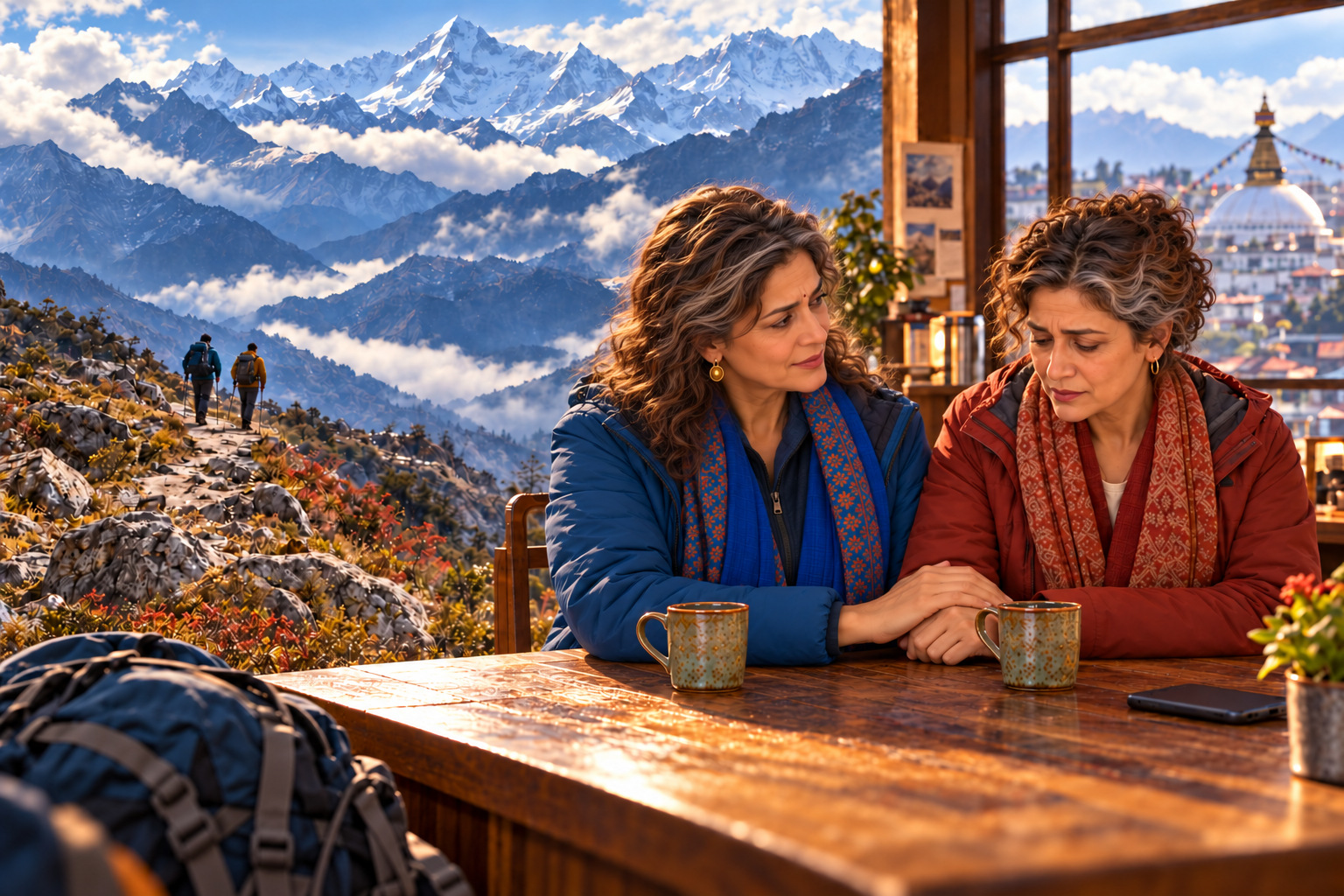
Chapter 11
Looking Up
In the years after that holiday, Vineet returned to the question of Everest more than once. There were journeys to prepare for—and mornings when getting out of bed to train was less attractive than imagining a mountain.
By his fiftieth birthday, the children were making plans for university. Later came applications, bags weighed on the bathroom scale, and instructions neither child had asked for. Once they were studying in the US, family calls had to fit around unfamiliar timetables. Shreya sometimes left the speaker on while they made breakfast, listening as Ananya or Aarav described an ordinary day.
On one of his early evenings back in Bengaluru, Aarav left a pair of shoes across the doorway. Vineet bent to move them, then heard his son laughing in the kitchen. He carried the shoes to the side and went to join them.
Visits home grew shorter when the children began working. His notebook acquired new pages.
Vineet still worked hard. Some weeks, he worked too much. But he learned to prepare a handover instead of taking an entire office on holiday.
Before one such break, Sid, his co-founder, sent him a plan to delay a release by a week. Vineet began typing instructions, then called him.
“You’ve already agreed to this?”
“With the team, yes.”
“And the client?”
“They’d rather wait than have us fixing it afterwards.”
Vineet looked at his unfinished reply. He still preferred the original date.
“Send me an update on Friday,” he said.
He deleted the instructions. Twice that afternoon, he opened the release schedule before remembering it was being handled.
At home, he arranged dinners and remembered more appointments. He still irritated Aarav by asking questions when the boy wanted company without them. There were arguments; Vineet missed fewer of those.
Shreya’s conservation work took her away for several weeks. Vineet joined her near the end and spent a morning watching her explain an old staircase to people who had arrived certain it should be removed. She stood in dusty shoes, sleeves pushed up, entirely absorbed.
He understood her wish better after seeing it than after all their discussions about dates.
Early in those years, on a family journey to Ladakh, he looked through a telescope beneath a sky so crowded that familiar constellations were difficult to find. His son, Aarav, stood beside him, impatient for his turn.
“Are you actually looking?” the boy asked.
“Yes.”
“You haven’t said anything.”
“I know.”
Vineet stepped aside. This time, Aarav was quiet too.
Waiting for another turn, his son began talking about whether to try for his school team again. Vineet started to offer advice, then heard, “Can I finish, Dad?”
He put his hands in his pockets and listened. When their turn came, Aarav was still speaking. Vineet let the family behind them go first.
Later came Finnish Lapland. Vineet and Shreya waited through two evenings of cloud. On the second, back indoors, he checked the forecast between every turn of their card game.
“Your turn,” Shreya said.
“One minute.”
“You said that three forecasts ago.”
He put down the phone and played. She examined his card.
“You were doing better when you weren’t paying attention.”
He laughed. They stayed up long after the tea was finished.
On the third evening, he was fumbling with a flask when she touched his arm.
At first, the light was faint enough to doubt. Then it moved across the dark, a green fold opening above the trees.
He reached for his phone and stopped. Shreya was looking up, her mouth slightly open, one mitten gripping his sleeve.
“You’re missing it,” she whispered.
He put the phone away.
Alaska followed several years later, when the children were grown and joining a family journey required negotiation across continents. There were other places: some beautiful, some less impressive than the photographs, all of them requiring someone to choose dates before work occupied them.
Ananya once remarked that her father had become more punctual since acquiring places he wanted to reach.
“I was always punctual,” Vineet protested.
“For meetings,” she said.
He could not dispute that.
The Everest journey resisted him.
He had long since settled what he meant: the walk to the mountain’s base camp, not an attempt on the summit. The distinction made the wish clearer without making the journey small.
On his first attempt, in his early fifties, he developed a persistent headache before reaching the highest stages. The guide advised descent. Vineet asked whether another night might make a difference. The answer remained the same.
He put his walking poles away, then took them out again. They were still needed for the way down.
That evening, when Shreya called, he described the lodge and the cold.
“Where are you now?” she asked.
“The food’s surprisingly good here.”
“Vineet. Where?”
“We’ve come down.”
She asked how he was feeling. He told her what the guide had said, then fell quiet.
“You could have told me first,” she said.
“I wanted to talk about something else.”
“Tell me about the food, then.”
He laughed reluctantly. When she asked again about his headache, he answered properly.
Two years later, deteriorating conditions ended another attempt. He came home with photographs, stronger legs, and a disappointment he tried unsuccessfully to disguise as indifference.
“You can be upset,” Shreya told him. “You don’t have to keep explaining how sensible you were.”
He laughed, then admitted how much he had wanted it.
He continued walking elsewhere. He took practical first-aid training after realising that wanting to help and knowing how were different things.
One evening, he told Shreya, “When I was younger, I used to imagine dying while saving someone. Or doing something for the country. I thought that would make my life count.”
She put down her cup.
“I’d rather have you here,” she said. “There’s plenty you can do while you are.”
He looked at her, then squeezed her hand.
Before his sixtieth birthday, he planned another attempt in Nepal. He trained, made the necessary arrangements, and allowed more time than his calendar would once have tolerated.
“I’d like to do it before sixty,” Vineet said, folding a walking shirt.
“I know. Just don’t turn a birthday into a deadline.”
He paused, then put the shirt in his bag.
Shreya would stay in Bengaluru this time. She had work to finish, and he would be travelling with an organised group. Before he left, they went through the itinerary together and agreed how they would keep in touch when reception allowed.
By then, Ananya and Aarav were both working in the US. In the family video call before the journey, his daughter asked about the guide, his itinerary, and how they would receive updates.
“You sound like you’re approving the trip,” Vineet said.
“Someone should,” Ananya replied.
Aarav leaned closer to his camera.
“Send us something when you can, Dad. Even if it’s only a message.”
“I will,” Vineet said.
“We’ll put the organiser’s contact details in the group too,” Shreya added.
After the call, she checked his bag and found the warm layer he had left beside it.
“Were you planning to buy another one halfway up?” she asked.
“I hadn’t finished packing.”
“You’d closed the zip.”
“Temporarily.”
She put it in and moved his phone charger to the smaller bag where he could find it.
At the doorway the following morning, he turned back for a second embrace. Shreya held him a little longer this time.
“Another attempt,” she reminded him.
He nodded. “I’ll call.”
Chapter 12
The Way Down
The photograph Vineet sent home showed six pairs of boots outside a lodge.
Mine are the cleanest, he wrote.
Shreya’s reply arrived while he was still holding the phone.
Then you’re not doing enough walking.
Across the room, Harish was trying to find his glasses. They were hanging from the cord around his neck.
“Don’t tell anyone,” he said when Vineet pointed. “I spent thirty-four years in a laboratory.”
“Looking for things?”
“Mostly explaining why other people had lost them.”
Harish was a retired scientist from Bengaluru. They had discovered this on their second evening, then spent ten minutes identifying roads, restaurants and a particularly troublesome junction they both used. They had lived twenty minutes apart for years without meeting.
Now they shared a room, a packet of roasted chana and the task of reminding each other where they had put things.
Outside one evening, Vineet had asked about a bright point above the ridge. Harish named it, then admitted that his work had involved materials, not astronomy.
“You can say you don’t know,” Vineet told him.
“At home, certainly. Here I have a reputation to establish.”
By the time the group approached its final stage towards base camp, Vineet had grown accustomed to Harish’s company. The older man did not hurry a silence or insist that every beautiful view required a photograph.
They reached Lobuche on an October afternoon, after the slower days set aside for acclimatisation. Gorak Shep, the last settlement before base camp, lay ahead. At dinner, the lead guide checked the forecast again; they would review the plan in the morning.
Harish left half his dinner.
“Not hungry?” Vineet asked.
“Tired. More than I expected.”
He had a headache too. When Vineet suggested telling the lead guide, Harish went with him without arguing. The guide checked him, arranged to monitor him overnight and told him to report any change immediately.
Back in their room, Harish tried his wife again.
“Still not answering?” Vineet asked.
“She usually calls back before I’ve put the phone away.”
When his wife did not answer, Harish called his son. He listened, then sat down on the bed.
“What kind of fall?”
Vineet looked away and began sorting his socks.
“Let me speak to her,” Harish said.
There was a pause.
“All right. Call me when she wakes up.”
He held the phone for a while after the conversation ended.
“She’s in hospital,” he told Vineet. “My son says they’re observing her. He says not to worry.”
“Is someone with him?”
“His aunt. He says everything is being managed.”
Harish lay down without taking off his glasses. A little later, Vineet reached over and switched off the light.
By morning, Harish felt no better. The lead guide asked Nima, the assistant guide who had been walking with their group, to take him down towards the aid post at Pheriche. They would pass through Thukla on the way. The others would continue towards Gorak Shep only if conditions remained suitable.
Harish was putting away his sleeping bag when his phone rang.
“Yes, I’m away,” he said. “Why?”
Vineet heard the change in his voice before he turned.
“What do you mean, she hasn’t regained consciousness?” Harish asked.
He stood very still.
The relative on the call had not known where he was. She had assumed he knew everything.
Afterwards, he called his son twice before the connection held.
“Tell me properly,” Harish said. “Please.”
Vineet stepped into the passage. Through the thin door came fragments: a head injury, the intensive care unit, doctors waiting to see how she responded.
Then Harish’s voice, louder.
“You should have told me she was in a coma.”
Vineet’s hand stopped on the doorframe.
“I was worrying already,” Harish said. “She wasn’t answering.”
When Vineet went back in, his friend was trying to close a buckle with fingers that would not settle.
“My son didn’t want me worrying up here,” Harish said. “As if I could do anything else now.”
Vineet drew the chair closer. He sat while Harish tried another call. This time, there was no connection.
Outside, the rest of the group was preparing to leave.
Vineet knew what lay ahead. He had imagined calling Shreya from the end of this walk, imagined writing a date beside the wish that had resisted him twice already.
Nima checked Harish’s equipment and spoke to the lead guide. Harish waited beside the wall, looking at his phone.
Vineet put his gloves on. Then he walked over to the guide.
“I’ll descend with them.”
“Nima will take care of him,” the guide said. “We’ve made arrangements.”
“I know.” Vineet glanced at Harish. “I’d like to go with him.”
The guide discussed the descent with him, checked how he was feeling and redistributed the equipment. They agreed on radio check-ins at the lodges along the route; the lead guide would pass on news when he could. Vineet tried sending Shreya a message, but the signal had gone again.
Harish looked up when Vineet joined him.
“You should be going up,” Harish said.
“I’m coming down with you.”
“You came all this way.”
Vineet adjusted the strap on his shoulder. For a moment, he could not quite make himself answer.
“Come,” he said at last. “Let’s get you down.”
At first, they made steady progress. Nima set the pace and stopped whenever Harish needed him to. Between those stops, Harish checked the blank corner of his phone where the signal should have been.
“My son will be trying,” he said.
“We’ll call as soon as we can,” Vineet replied.
Towards midday, on the descent towards Thukla, the wind strengthened. Fine snow blew across the trail and collected in the folds of their clothes. The ridge that had been clear a few minutes earlier disappeared.
Nima brought them closer together. In clear weather, he explained, the lodge at Thukla would have been less than an hour away. He would reassess there before attempting the rest of the descent.
“Stay behind me,” he said. “If you need to stop, call out.”
Harish nodded, but after several more minutes he stopped abruptly.
“My heart,” he said. “It’s going too fast.”
He was struggling to finish the sentence.
Vineet called Nima back. Together they helped Harish rest in the most sheltered position they could find. Nima assessed him, then moved a few paces away to try his radio. Vineet stayed beside Harish. He did not know how much of what he was seeing belonged to illness, altitude or fear. None of it looked safe to dismiss.
“I should be with her,” Harish said.
“Your son is there.”
“We argued before I left.”
Vineet bent closer to hear him above the wind.
“About the cupboard,” Harish said. “I left everything on the bed. Such a stupid thing.”
His face crumpled in a way Vineet had not expected.
Vineet put a hand on his shoulder.
He kept his hand there while Harish struggled to speak.
Harish spoke in broken pieces. Vineet stayed with him while Nima tried the radio again. He wanted to say that his wife would recover, that they would be home soon. Instead, he told Harish when the guide was coming back and what they would do next.
The cold worked through Vineet’s gloves. His own fingers were becoming clumsy.
Nima returned with a decision. They could not safely continue at their earlier pace. He had made brief radio contact with someone at the lodge; help was coming towards them. They would move to a more protected place nearby and wait.
The distance was short. It took far longer than Vineet expected.
Once, Harish’s knees gave beneath him. Vineet caught his arm while Nima steadied him from the other side. As they shifted their weight, Vineet’s boot slid off the edge of a stone.
Pain shot through his ankle. He went down on one knee.
For a moment, he said nothing. Then he tried to stand.
“Wait,” Nima said.
Vineet could not put his weight on the foot. Nima helped him sit, checked the injury and brought out an extra layer. Harish watched, stricken.
“Don’t,” Vineet said before his friend could apologise. “Let him work.”
Nima made another radio call. Vineet heard only the words nearest him.
“One injured, one unwell. Both need evacuation.”
The reply broke into static. Nima repeated their location and names. Somewhere beyond the ridge, the request would have to be passed on again.
By the time two local men reached them, the world beyond the nearest rocks had vanished into blowing white.
They reached the lodge at Thukla as the afternoon light began to fade. The men had helped them cover a distance Vineet would once have dismissed as a short walk.
Harish was settled near the stove while Nima arranged help for both of them. Vineet sat with his leg supported, shivering despite the layers around him. The weather had stopped any immediate evacuation.
He took out his phone. There was the photograph of the boots, Shreya’s answer beneath it.
Coming down with Harish. I’ve hurt my ankle. We’re at a lodge with Nima. Will call as soon as I can.
He tried to stand when the guide returned. Pain stopped him before he had straightened.
“Sit,” Nima said. “We’re arranging help.”
Vineet looked at the message to Shreya.
It was still waiting to send.
Chapter 13
The Waiting
In Bengaluru, Shreya reheated her dinner and left it beside the microwave.
She had been working when Vineet usually called. Now the drawings were closed, the kitchen was quiet, and there was still no message.
He had warned her about irregular contact. She reminded herself of this while opening their conversation again.
The boots were still the last photograph.
She called the trek organiser’s Indian number. The man promised to check with the team in Nepal. When he rang back, she was already holding the phone.
The news had come through another guide. Vineet had descended with an unwell trekker. Now one man was injured, the other seriously unwell, and both needed evacuation. The organiser had not spoken directly to Nima, the assistant guide with them.
“Which one is Vineet?” Shreya asked.
“We haven’t confirmed that yet. I don’t want to tell you the wrong thing.”
“Has somebody spoken to Vineet?”
“Not directly. We’re trying to reach Nima.”
Shreya gripped the edge of the table. She could hear the hospital monitor from years earlier as clearly as if it were in the room.
“Please don’t wait for good news to call me. Tell me what you know.”
Afterwards, Shreya opened her contacts and stopped at Sid’s name. She sent him the organiser’s number and asked him to call. Then she opened the family group. Ananya had sent a photograph of a meal she was proud of. Aarav had replied with a comment about the size of the plate.
She began typing, erased it, and opened Mahira’s contact.
Over the years, Mahira had become someone Shreya could call before she had worked out what to say. Sometimes she stayed on the line while Shreya found her keys or finished eating. Neither felt obliged to keep the conversation going.
Now Shreya pressed call and put the phone against her ear.
“Are you busy?” she asked.
At her office in Hyderabad, where she had stayed late to finish a drawing, Mahira pushed it aside.
“What happened?”
Shreya repeated the organiser’s account. Halfway through, she lost the order and began again.
“Are you alone?” Mahira asked.
“Yes.”
“Have you called the children?”
“Not yet. I don’t know what to tell them.”
“Tell them what you’ve told me. They should know.”
Shreya pressed her fingers against her forehead.
“I think I should go to Kathmandu.”
“Then we’ll work out how.”
“Can you stay on the phone a minute?”
Mahira stopped reaching for her laptop.
“Yes,” she said. “I’m here.”
Mahira checked flights as soon as Shreya ended the call to speak to the children. She could reach Bengaluru that night and travel onwards with Shreya the following morning. She checked the time between the journeys twice before calling Sameer.
“I’m going with Shreya,” she said. “Vineet needs evacuation. They haven’t confirmed his condition.”
Her husband asked what had happened. She told him what little she knew.
“Are you coming home first?” he asked.
“There isn’t time.”
“Have you got your travel ID?”
She checked her handbag. “Yes.”
“Send me the booking. I’ll call you on the way.”
She left instructions for a colleague, put the same file down in the wrong place twice and went back for her phone. In the lift, she realised she was still holding a fabric sample.
She put it in her bag. There was no time to take it upstairs.
By the time Mahira reached Shreya’s home, Ananya had booked the earliest journey she could manage from the US. Aarav was speaking to the organiser and arranging his leave, ready to follow if needed. He stayed on a video call while his mother packed.
Shreya opened the door before Mahira rang.
For a few seconds, they held each other without speaking.
Then Shreya stepped back and looked at the laptop bag.
“You came straight from work?”
“Apparently I’ve packed enough to redesign the airport.” Mahira put the bag down. “Have you eaten?”
Shreya shook her head.
Mahira went to the kitchen. The plate beside the microwave was cold again.
While they ate a little, Shreya showed her the notes from the calls. One sentence had been written three times. Mahira asked which number belonged to the Nepal contact and saved it on her own phone.
They slept badly for a few hours. Every vibration from either phone brought them upright.
At the airport the next morning, Mahira checked their documents while Shreya read out the address their contact had sent. They saved it on both phones and sent it to Ananya.
Before boarding, Mahira called Sameer. When she returned, Shreya held out a packet of biscuits.
“You haven’t eaten either.”
Mahira looked at it, then took one.
In Kathmandu, they left their bags at the hotel arranged through the organiser and went to the local office.
A map covered one wall. Shreya had seen the route on Vineet’s screen many times. Here the distances seemed different. A finger could cross in a second what had taken him days to walk.
The office confirmed that both men were sheltered at a lodge at Thukla. Help had been requested, but the weather was still delaying the evacuation. They were trying to reach Nima again for a direct update on each man’s condition.
“What do you know for certain about their condition?” Mahira asked.
Shreya wrote down the answers. Mahira found water and sent an update to the children. Ananya was between flights. Aarav replied almost at once: Keep your phones charged. I’ll speak to them again.
Then there was nothing useful to do.
Shreya watched a man outside carry a stack of plastic chairs across the street. He dropped one, laughed at something someone said, and picked it up.
She turned away from the window.
“When he was in hospital during the pandemic, I used to hate this part,” she said.
“Which part?” Mahira asked.
“Everything carrying on.”
Mahira moved her chair closer. She did not offer an answer.
The confirmation came that afternoon.
Nima, the assistant guide, had been reached directly. It was Harish who had become unwell. Vineet had injured his ankle while helping him and could not walk safely. They were both conscious and talking.
The organiser repeated what Nima had confirmed. Both men were still at Thukla. Vineet could not walk safely on the injured ankle. A medical evacuation had been requested, and the team was waiting for conditions to allow it.
Shreya leaned forward.
“Vineet,” she said. “You’re certain?”
The organiser repeated his name and the details.
Beside her, Mahira asked, “Was he speaking?”
“Yes.”
“And they have someone with them?”
“Yes, ma’am.”
Mahira nodded. She looked towards the map. “And someone is staying with him until they can move?”
“Yes. Nima is with them.”
Shreya turned towards her.
Mahira’s hand was trembling against the paper cup. She put it down before the water spilled and stared at it, as though surprised by her own fingers.
Shreya took her hand. Mahira tried to smile, but it did not hold.
Neither woman explained.
When Ananya called, Shreya answered with her free hand.
“They’ve spoken to the guide. Dad is talking,” she said. Then, because her daughter had begun crying, she said it again.
The next morning, the organiser came to them before Shreya could ask. Both men had been evacuated. They were on their way to a medical centre in Kathmandu.
For a moment, she could only look at him. Then she called Aarav. Mahira sat down beside her and covered her face with her hands.
That afternoon, Shreya waited outside an observation room. Ananya had arrived and was beside her. Aarav was waiting for their call in the US, where they had asked him to stay until they knew more.
The doctor confirmed that Vineet had an ankle fracture. He was being treated for cold exposure and would need observation, but he was stable. Harish was receiving treatment too.
Weather and interrupted communications had delayed both help and reliable news. Hearing the sequence explained did not give Shreya back the hours when she had known none of it.
Ananya embraced her father and then inspected him with an expression that made him look away. She held out her phone. Aarav was on the screen.
“You could have sent a better photograph,” his son said.
“The boots?” Vineet asked.
Aarav nodded, wiping his face with the heel of his hand.
Mahira came in with Shreya after the doctor had finished speaking. She stopped beside the bed.
“You look tired,” she said.
“So do you.”
She tried to smile, but her eyes filled. Vineet noticed her turn her face slightly away. He waited while Shreya drew a chair closer for her.
“Thank you for coming with her,” he said.
“I’m glad we’re taking you home,” Mahira replied.
A little later, Ananya asked Mahira to come with her to find tea, leaving the couple together.
“You frightened me,” Shreya said.
“I know.”
“You know I was frightened. You don’t know what it was like.”
He looked at her.
“Tell me.”
She did. He listened without interrupting to explain the route or defend his decision. When she stopped, he kept holding her hand.
Later, he told her about Harish’s phone call, the bag he could not fasten and the moment the others had started towards the mountain.
“I wanted to keep going,” he admitted. “I still wish I could have.”
“I know.”
“And I couldn’t leave him.”
Shreya adjusted the blanket over his feet.
“I’m glad you went with him,” she said. “I’m still angry about those hours. Let me be both.”
He nodded.
Before they left Nepal, Harish received a call from his son while Vineet was beside him. His wife had regained consciousness. Her recovery remained uncertain and would take time, but she had recognised their son’s voice.
Harish listened with his head bowed. Then he asked to hear her, even if she could not speak.
Vineet stepped outside.
When Harish came out later, neither man attempted to discuss the mountain.
“We’re twenty minutes apart,” Harish said. “You’d better come.”
“When you’re ready.”
“My wife will want to know who brought her troublesome husband back.”
Vineet smiled. “Mine has a few questions for you too.”
Chapter 14
Here, Together
At home, Ananya reorganised the kitchen in the name of helping. Vineet tried to object when she moved his usual cup.
“You can recover without supervising everything,” she told him.
He recognised something of Shreya in the sentence and decided not to say so.
Ananya returned to the US once he was recovering well. The house grew quiet again. This time, he did not immediately fill the silence with work.
One afternoon, Aarav called while Vineet was speaking to Sid. Vineet sent his son a message saying he would call in fifteen minutes. He finished the discussion with Sid and called Aarav back when he had promised.
Aarav wanted to talk about an apartment he was considering. For twenty minutes, Vineet looked at photographs of windows, a kitchen and a patch of wall his son thought might hold a bookshelf. There was no emergency. Vineet stayed on the call.
A few weeks later, he took the notebook from its drawer.
The early pages were crowded with amendments. There were dates beside some journeys, question marks beside others. A few wishes had been crossed out because he no longer wanted them.
He stopped at the first mountain entry.
Base camp remained unfinished. He could still feel the disappointment. He left the words as they were, without adding another date.
Further down were places where he had stood under skies he once knew only from pictures. He remembered Shreya gripping his sleeve beneath the moving lights in Finland. The two cloudy evenings before that had given them time for cards and terrible jokes.
He paused at the entry he had once thought impossible. The conversation had happened. There was nothing more he needed to ask of it. He turned the page.
The sentence about helping someone stayed open. Harish had called that morning: his wife was asking impatient questions about her treatment. Vineet had promised to visit when she was ready.
He turned back to the first page. He would never be grateful for the illness during the pandemic. But without that hospital bed forcing him to stop, he wondered when he would have thought to begin this list.
Sid had sent an update that morning: the team had resolved a release problem without waiting for him. Vineet had read it, asked one question and put the phone away.
“Tea?” Shreya asked from the doorway.
He looked up.
“I’ll bring it.”
“That wasn’t an examination.”
“Good. I hadn’t prepared.”
She smiled and went towards the balcony.
The swing moved slightly as he put down the tray. Shreya drew up her feet, making room beside her.
He sat down and poured their tea.
She noticed the notebook.
“Planning something?”
“Possibly.”
“Should I sit further away?”
Vineet opened a fresh page and wrote a short heading: Together. Beneath it, he began a sentence.
Shreya leaned closer.
A week in an old town by the sea. Walk through the streets. No project visits.
She looked at him.
“You remember that?”
“You said three days would be enough.”
“I was trying to sound reasonable.”
“I’ve allowed for that.”
She read the line again.
Vineet handed her the pen.
Shreya added: No checking out early because a client has found a crisis.
“That applies to you too,” he said.
“I know.”
They added a longer visit to the children, with time to see the lives they had built rather than spend the entire journey waiting for a free weekend.
There was space beneath the wishes. Neither hurried to fill it.
Beyond the balcony, a few stars were beginning to survive the city lights. Shreya rested the notebook across their knees and thought of one more thing she wanted them to do.
Vineet listened, his tea cooling beside him.

There were wishes still unfinished. Beside Shreya, adding another to their list, Vineet no longer felt that his life was waiting to begin.
Share your thoughts
I’d love to hear your thoughts. What connected with you, and what could be better? Share your feedback privately through Contact Us—a few words are enough.
Please mention the story title and part number.

