Category: Perspectives

Personal reflections, observations and lessons worth sharing.

  • Navdurga: Nine Forms, Countless Strengths — A Lifetime to Celebrate Her

    Navdurga: Nine Forms, Countless Strengths — A Lifetime to Celebrate Her

    The wisdom of Navdurga, the many expressions of Shakti, and a celebration that goes beyond nine days.

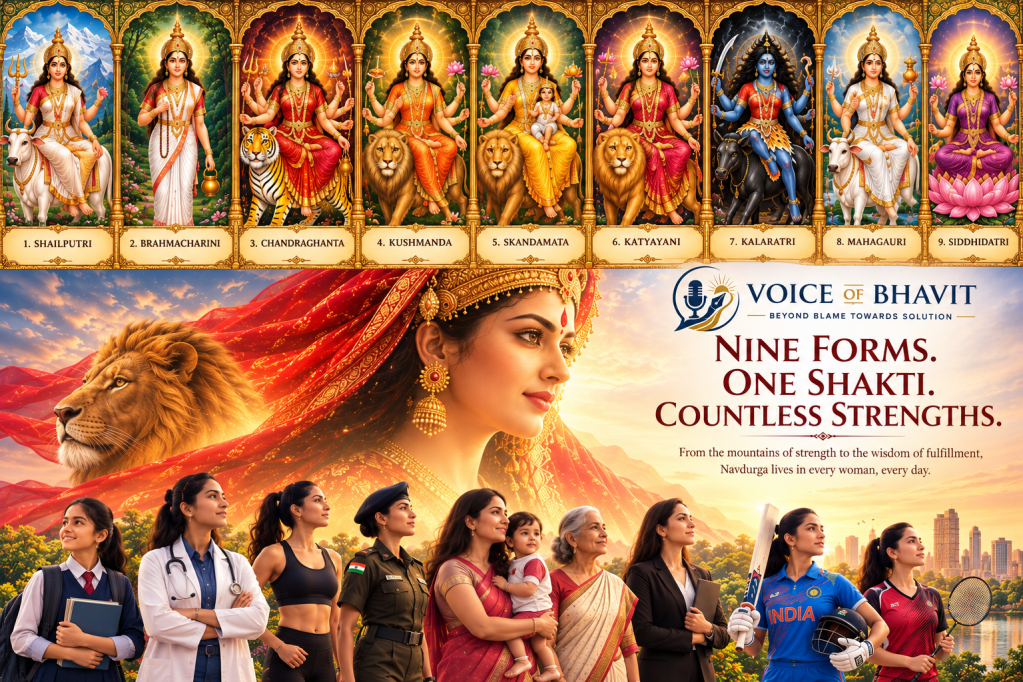
    Every Navratri, we worship Maa Durga in her nine divine forms, each with its own identity, appearance, symbolism and significance.

    Each Swaroop carries distinct attributes, ornaments and, in many depictions, different astras and shastras — reflecting the many expressions of divine power.

    But have we ever paused to wonder why the same divine mother is worshipped in nine different forms?

    Perhaps there is a beautiful lesson hidden in this diversity.

    Life cannot always be approached with the same emotion, the same response or the same kind of strength.

    Sometimes life calls for patience, sometimes compassion, sometimes wisdom, and sometimes, when faced with injustice, fearless courage.

    Nine Forms, Nine Lessons for Life

    Maa Shailputri represents stability, determination and inner strength.

    Maa Brahmacharini represents discipline, devotion and perseverance.

    Maa Chandraghanta represents courage and readiness to face challenges.

    Maa Kushmanda represents creative energy, positivity and new beginnings.

    Maa Skandamata represents motherhood, unconditional love, nurturing and protection.

    Maa Katyayani represents determination and the courage to stand against injustice.

    Maa Kalaratri reminds us that confronting darkness and evil sometimes requires fierce and fearless strength.

    Maa Mahagauri represents purity, peace and inner transformation.

    Maa Siddhidatri represents wisdom, spiritual accomplishment and fulfilment.

    Nine forms. Nine expressions of divine power. One Shakti.

    True strength is not about being fierce all the time. It is about having the wisdom to know when to be gentle, when to remain patient and when to stand fearless.

    The Shakti We See Every Day

    Isn’t it remarkable how these qualities are reflected in the women around us?

    Think about a mother.

    She may comfort her child with extraordinary tenderness, yet become fearless when that child’s safety is threatened.

    A daughter may fill her home with laughter and affection, yet demonstrate remarkable determination when pursuing her dreams.

    A wife may bring patience and understanding to life’s challenges, yet stand firmly for what she believes is right.

    A woman may be a mother, daughter, sister, wife, professional, friend or leader — sometimes fulfilling several of these roles in a single day.

    She may nurture, guide, create, lead or protect, depending on what life demands.

    Yet beyond every role, she remains an individual with her own identity, aspirations and dreams.

    Just as Navdurga represents different expressions of Shakti, the women around us demonstrate different strengths through the many situations they encounter in life.

    Perhaps we have been witnessing these expressions of Shakti all along, without always pausing to recognise them.

    From Worshipping Shakti to Living Its Values

    For thousands of years, our Sanatan traditions have recognised and worshipped the feminine as divine power.

    Navratri celebrates this profound philosophy through devotion, prayers, colours, music and Garba.

    But the values behind the celebration are not limited to nine days.

    Respect for women begins in the way we live, the relationships we build and the values we pass to the next generation.

    When children grow up seeing dignity and equality practised at home, these principles become a natural part of their character.

    When sons learn to respect women as equals, and daughters grow up knowing their voices and choices matter, we move closer to a society where dignity is never dependent on gender.

    India has come a long way in recognising and celebrating women’s capabilities. Across education, science, defence, sports, entrepreneurship and leadership, women continue to demonstrate extraordinary achievements.

    These achievements are not about women becoming powerful for the first time. They are expressions of the strength, intelligence and determination they have always possessed.

    We have made meaningful progress. Let us continue this journey towards a society where women’s independence, choices and achievements are simply a natural part of life — not something that needs special justification or approval.

    Nine Days of Worship, a Lifetime of Celebration

    This Navratri, let us celebrate Maa Durga in all her divine forms and appreciate the women whose presence enriches our lives.

    Let us celebrate their love without expecting endless sacrifice, admire their courage without expecting them to fight every battle, and recognise their achievements without defining them through any single role.

    A woman may be gentle or fierce, nurturing or ambitious, patient or determined. She may embody many of these qualities at different moments in life.

    She does not need to become Shakti. She already is.

    Perhaps that is the most beautiful connection between Navdurga and the women around us.

    Nine divine forms remind us that power has many expressions. Everyday life reminds us that those expressions are not confined to a festival.

    Nine days to worship Navdurga. A lifetime to recognise, respect and celebrate the Shakti around us.

    Shubh Navratri! Jai Mata Di!

    — Voice of Bhavit

    Thoughts that Speak, Values that Inspire.

  • From Outcry to Contribution: What Happens After We Raise Our Voice?

    Raising our voice when a system fails is important. But when an opportunity comes to help improve it, can we bring the same energy to contribution?

    When something goes wrong in a public system, people speak up. We question. We debate. We post. We demand answers.

    That public voice matters. Accountability matters. Silence is not the answer when systems fail.

    But I have increasingly found myself thinking about what happens after the outcry.

    A door opened for participation

    In 2026, the Government of India constituted a High-Powered Task Force on reforms in public examinations under the chairmanship of Nandan Nilekani.

    On 28 August 2026, the Task Force publicly invited suggestions from stakeholders, with submissions open until 13 September. The official invitation covered areas including examination security and integrity, institutional systems and processes, appropriate technologies, infrastructure, accessibility and inclusion, and student well-being.

    The invitation sought experience, knowledge and perspectives from stakeholders and stated that the inputs from the public consultation would assist the Task Force in formulating its recommendations to the Government.

    For me, that created an interesting contrast.

    Did we create the same awareness around the opportunity to contribute that we created around the problem?

    I am not suggesting that people did not participate. I do not have data that would justify such a conclusion.

    My question is different.

    When a failure becomes visible, public awareness can spread very quickly. But when a consultation, suggestion process or opportunity to participate opens later, do we make an equal effort to tell people about it? Do we share the opportunity with the same urgency with which we shared the problem?

    Contribution does not require us to be experts in everything

    I submitted my own suggestions and used my social-media space to encourage others to look at the consultation and contribute if they had something useful to offer.

    I mention this not as an achievement. I do not claim to have the answers to examination reform.

    It was simply an opportunity to participate, and I felt participation was more useful than stopping at frustration.

    Contribution does not always mean designing an entire policy. It may mean sharing an idea from our own experience, offering relevant expertise, pointing out an implementation difficulty, creating awareness of a consultation, connecting knowledgeable people to the process, or simply encouraging someone better informed to participate.

    Accountability and contribution can coexist

    Moving towards solutions does not mean moving away from accountability.

    When institutions fail, asking questions is legitimate. Investigations, responsibility and corrective action may be necessary.

    But accountability and participation do not have to compete with each other.

    We can ask what went wrong and ask what could work better. We can expect institutions to improve and contribute our experience when institutions genuinely invite it. We can criticise a loophole and help think about how it might be closed.

    From spectators to participants

    Democratic participation and engagement with public institutions do not operate only on election day or during moments of controversy.

    There are consultations, local initiatives, community efforts, public-feedback processes and many smaller opportunities through which citizens can participate.

    Not every process will be perfect. Not every suggestion will be accepted. Participation does not guarantee that an idea becomes policy.

    But perhaps that should not stop us from contributing when a credible opportunity exists.

    If we want systems to become better, our role need not end after identifying what is wrong.

    Is there something useful I can contribute?

    That contribution may be small. But many meaningful changes begin with people deciding not merely to observe a problem, but to participate in improving what comes next.

    Don’t stop raising your voice. But when the door to contribution opens, step through it.


    Source: Government of India, Press Information Bureau, 28 August 2026 — High-Powered Task Force invitation for suggestions on reforms in public examinations.

  • The Skill Behind Every Revolution: Adaptability

    From machines to computers, the internet and now AI, technology has repeatedly changed how humans work and live. Perhaps the enduring skill is not knowing everything about the next revolution — but being ready to adapt when it arrives.

    Every era has its important skills. Technical knowledge matters. Communication matters. Creativity matters. Leadership matters.

    But underneath many of them sits another capability: the willingness and ability to learn, adjust and move forward when the environment changes.

    Technological revolutions are not new

    Mechanisation changed physical work. Electricity and mass production transformed factories and industries. Computers digitised tasks and information. The internet and mobile technologies changed communication, commerce and access to knowledge. Online platforms created new ways to work, buy, sell and collaborate.

    Now AI is beginning another significant transformation.

    Every major technological transformation changed what humans did, how they worked and which skills created value. Those who could learn, adjust and use the new tools were better positioned to participate in the opportunities that followed.

    The revolutions are not new. The speed is.

    The World Bank’s World Development Report 2026 notes how quickly AI is spreading compared with earlier general-purpose technologies. It estimates that the steam engine took about 80 years to reach lower-income countries, electricity about 40 years and the internet about 20 years. By comparison, middle-income countries accounted for half of ChatGPT’s global traffic within six months of its launch.

    AI makes adaptability more visible

    The conversation around AI can easily become “human versus machine.” The reality is more nuanced.

    The International Labour Organization’s 2025 research found that around one in four workers globally were in occupations with some degree of generative-AI exposure. Importantly, it concluded that transformation of jobs is more likely than wholesale replacement because many tasks still require human input.

    The World Economic Forum’s Future of Jobs Report 2025 similarly found that surveyed employers expected 39% of workers’ existing skill sets to be transformed or become outdated by 2030. Alongside AI, big data and technology literacy, employers highlighted human capabilities such as creative thinking, resilience, flexibility, agility, curiosity and lifelong learning.

    None of this tells us exactly what every profession will look like years from now. It does suggest a more useful question than simply asking whether AI will replace a particular job:

    How will my work change — and am I prepared to change with it?

    Unlearning is not forgetting

    “Learn, unlearn, relearn” is often repeated when people talk about adaptability. But unlearning does not mean throwing away everything we already know.

    Experience still matters. Knowledge matters. Judgement matters. Relationships and values matter.

    Unlearning means being willing to question a method or assumption when the world around it has changed.

    A simple framework can help:

    • What should I retain?
    • What should I change?
    • What do I now need to learn?

    Adaptability is not abandoning our foundation. It is knowing which parts of the foundation remain valuable while being willing to build differently on top of it.

    What should we teach the next generation?

    If the tools young people use throughout their careers will keep changing, education cannot prepare them only by teaching today’s tools.

    It can also develop curiosity, questioning, experimentation, independent learning, problem-solving and comfort with learning new skills.

    One of the greatest things we can teach the next generation may not simply be what to learn, but how to keep learning when the world changes.

    And this is not only a lesson for children.

    Adults model adaptability too. When we remain curious, learn unfamiliar tools and admit that an old method may no longer be the best one, we demonstrate that learning has no age limit.

    The next revolution will not be the last

    AI feels transformative today. It will not be humanity’s final technological change.

    There will be new tools, new industries, new ways of working and challenges we cannot yet describe.

    We cannot prepare for every future technology by memorising it in advance. But we can build the habit of responding to change with curiosity rather than paralysis.

    Learn what matters today.
    Question what no longer works.
    Unlearn when necessary.
    Relearn what tomorrow requires.

    Because perhaps the most future-ready skill is not any one technology.

    It is the ability to adapt.


    Sources: World Bank, World Development Report 2026: The Promise of Artificial Intelligence; International Labour Organization, Generative AI and Jobs: A 2025 Update; World Economic Forum, Future of Jobs Report 2025.